
Paper and measurement
ECG paper and calibration
Boxes, speed and gain
Every measurement on an ECG depends on two settings: paper speed and gain. At the standard 25 mm/s and 10 mm/mV, each small box is 40 ms wide and 0.1 mV tall.
Last updated
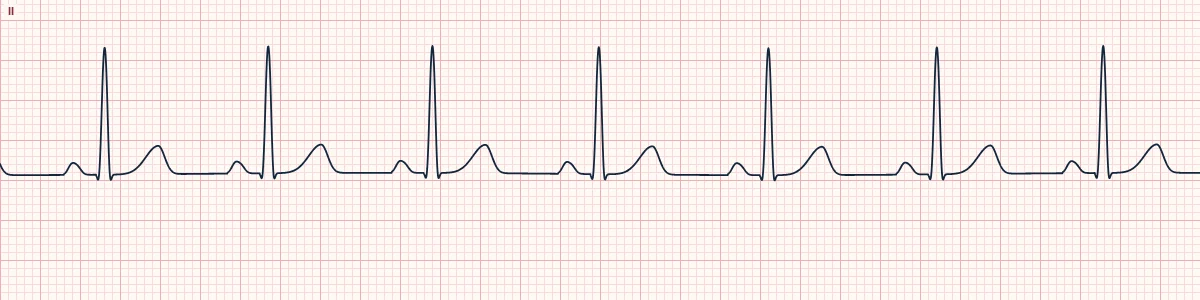
Example tracing, drawn by the lab's engine. Open the lab for a live, adjustable version.
At a glance
- Small box
- 1 mm = 40 ms = 0.1 mV
- Large box
- 5 mm = 200 ms = 0.5 mV
- Standard speed
- 25 mm/s
- Standard gain
- 10 mm/mV
Figures
Still images drawn by the lab's engine at 25 mm/s and 10 mm/mV, with the finding labeled. Select a figure to enlarge it.

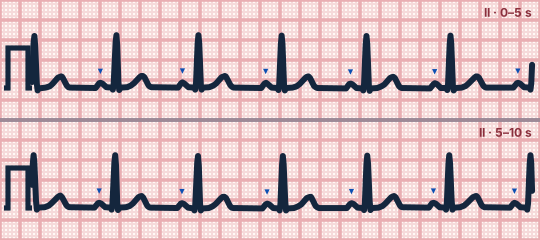
Scroll sideways to see the whole tracing, or select it to enlarge.
Time runs left to right
At 25 mm/s each 1 mm small box is 0.04 s (40 ms) and each 5 mm large box is 0.2 s (200 ms). Five large boxes make one second, so a standard 10-second 12-lead is fifty large boxes wide.
Voltage runs up and down
At the standard gain of 10 mm/mV, a 1 mV signal is 10 mm tall: two large boxes. The calibration pulse at the start or end of a printout is a 1 mV step and should be exactly that tall and square.
Why the settings matter
Halving the gain halves every amplitude, so voltage criteria for hypertrophy or ST elevation change meaning. Doubling the paper speed to 50 mm/s doubles every interval on the page. Check the settings before measuring anything.
How to read it
- Find the calibration pulse and confirm it is 10 mm tall.
- Read the paper speed printed on the strip; most countries use 25 mm/s.
- Use the Calipers button on the live tracing above to measure an interval in milliseconds and boxes.
Pitfalls
- Half-standard gain (5 mm/mV) is used when complexes are very large; voltage criteria then need doubling.
- Some monitors print at 50 mm/s, which makes a normal rhythm look slow and wide.
Key numbers
- Small box
- 1 mm = 40 ms = 0.1 mV
- Large box
- 5 mm = 200 ms = 0.5 mV
- Standard speed
- 25 mm/s
- Standard gain
- 10 mm/mV
- One second
- 5 large boxes
Advanced Down to the ion channel
What the cells are doing
Pacemaker, atrial and ventricular action potentials, in step with the tracing above, with sodium, calcium and potassium moving through their channels.
Frequently asked questions
ECG paper and calibration: what is the key idea?
Every measurement on an ECG depends on two settings: paper speed and gain. At the standard 25 mm/s and 10 mm/mV, each small box is 40 ms wide and 0.1 mV tall.
ECG paper and calibration: what are the key numbers?
Small box: 1 mm = 40 ms = 0.1 mV; Large box: 5 mm = 200 ms = 0.5 mV; Standard speed: 25 mm/s; Standard gain: 10 mm/mV; One second: 5 large boxes.
ECG paper and calibration: how do you apply it to an ECG?
Find the calibration pulse and confirm it is 10 mm tall. Read the paper speed printed on the strip; most countries use 25 mm/s. Use the Calipers button on the live tracing above to measure an interval in milliseconds and boxes.
ECG paper and calibration: what are the common pitfalls?
Half-standard gain (5 mm/mV) is used when complexes are very large; voltage criteria then need doubling. Some monitors print at 50 mm/s, which makes a normal rhythm look slow and wide.
Sources
This page does not list page-specific sources yet.
Every source the site cites, with links