
Occlusion MI and ischemia signs
Draft — pending owner review
Shark fin (lambda wave) ST elevation
QRS, ST and T fused into one triangle
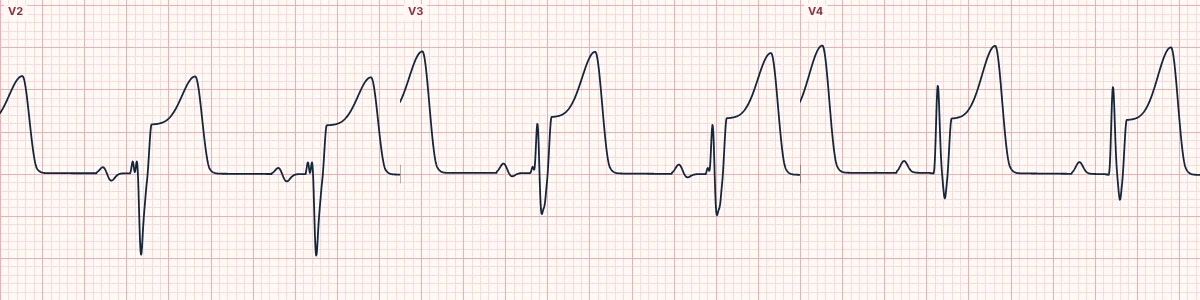
In a massive acute infarction the ST elevation can be so large that the QRS, ST segment and T wave fuse into one wide triangle, like a shark's fin or the Greek letter lambda. It signals a large territory and a high risk of shock and VF.
What it looks like
The R wave runs straight up into the ST segment with no visible J point, and the whole complex comes down in one slope. Because the complex looks wide, it is easily misread as a bundle branch block, a ventricular rhythm or hyperkalemia.
Where it comes from
Usually an acute proximal occlusion with a large area of transmural injury: the injury current lifts the end of the QRS and swallows the ST segment. The name lambda wave is also used for a similar triangular J-point and ST elevation reported in the inferior leads of some patients who died suddenly.
About the demonstration
The lab draws a proximal LAD occlusion with large ST elevation; it does not reproduce the most extreme, fully fused shape. Look for the same idea in the tracing: an ST segment that leaves the QRS high and has no flat portion.
How to read it
- Find the J point: if you cannot, part of the apparent QRS may be ST elevation.
- Look for reciprocal ST depression in the opposite leads, which a bundle branch block would not explain.
- Treat as an occlusion MI and prepare for arrhythmia.
Pitfalls
- Measuring the QRS across the fused wave overestimates its width and suggests a ventricular rhythm.
- Severe hyperkalemia also produces bizarre wide complexes: check the potassium.
Frequently asked questions
Shark fin (lambda wave) ST elevation: what is the key idea?
In a massive acute infarction the ST elevation can be so large that the QRS, ST segment and T wave fuse into one wide triangle, like a shark's fin or the Greek letter lambda. It signals a large territory and a high risk of shock and VF.
Shark fin (lambda wave) ST elevation: what are the key numbers?
Shape: QRS, ST and T fused into one triangle; Meaning: Large acute transmural injury; Risk: Cardiogenic shock and ventricular fibrillation; Common misreads: Wide-QRS rhythm, bundle branch block, hyperkalemia.
Shark fin (lambda wave) ST elevation: how do you apply it to an ECG?
Find the J point: if you cannot, part of the apparent QRS may be ST elevation. Look for reciprocal ST depression in the opposite leads, which a bundle branch block would not explain. Treat as an occlusion MI and prepare for arrhythmia.
Shark fin (lambda wave) ST elevation: what are the common pitfalls?
Measuring the QRS across the fused wave overestimates its width and suggests a ventricular rhythm. Severe hyperkalemia also produces bizarre wide complexes: check the potassium.