
Atrial
Atrial bigeminy
Every sinus beat is followed by a premature atrial complex, so the beats arrive in pairs with a pause after each pair.
Last updated
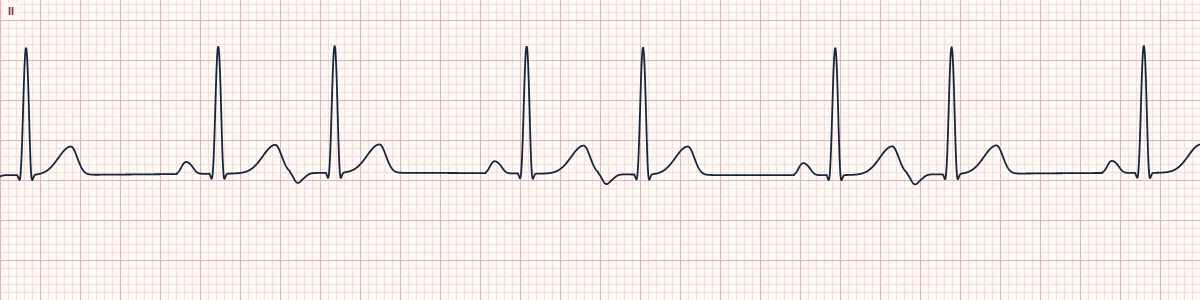
Example tracing, drawn by the lab's engine. Open the lab for a live, adjustable version.
At a glance
- Rate
- Depends on the sinus rate; beats come in pairs
- Rhythm
- Regularly irregular (short–long–short–long)
- P waves
- Alternating sinus P and early, different P
- PR interval
- ≥ 120 ms; the early beat's PR may be longer
Figures
Still images drawn by the lab's engine at 25 mm/s and 10 mm/mV, with the finding labeled. Select a figure to enlarge it.
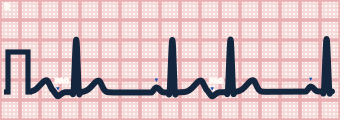
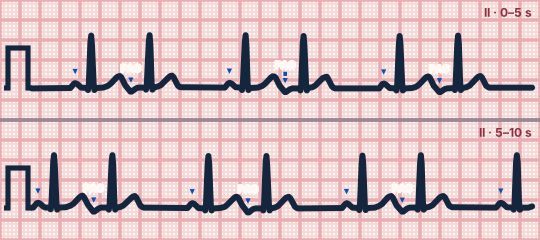
Scroll sideways to see the whole tracing, or select it to enlarge.
What the heart is doing
An atrial focus fires at a fixed interval after every sinus beat. Each ectopic impulse conducts to the ventricles and resets the sinus node, producing the repeating short–long pattern.
Why it looks this way
This is atrial bigeminy because every second beat is a premature narrow complex preceded by an early, differently shaped P wave.
Why it matters
Usually benign, but it reflects an irritable atrium and may precede atrial fibrillation. If the early P waves fail to conduct, it can masquerade as sinus bradycardia.
What to look for
- Look for group beating: pairs of narrow complexes separated by pauses.
- The second beat of each pair has an early P wave of a different shape, often on the T wave.
- Both QRS complexes of each pair look alike, unlike ventricular bigeminy.
Criteria
- Rate
- Depends on the sinus rate; beats come in pairs
- Rhythm
- Regularly irregular (short–long–short–long)
- P waves
- Alternating sinus P and early, different P
- PR interval
- ≥ 120 ms; the early beat's PR may be longer
- QRS
- Narrow on both beats
Causes
- Caffeine, alcohol, stimulants
- Atrial enlargement or stretch
- Hypoxia and lung disease
- Electrolyte disturbance
- Digoxin toxicity
- Early sign before atrial fibrillation
Can be mistaken for
- Ventricular bigeminy — the early beat is wide with no P wave before it Compare
- 3:2 Wenckebach — P waves arrive on time and the PR lengthens before a dropped beat
- Sinus bradycardia — if the early P waves are blocked and hidden in the T waves Compare
Advanced Down to the ion channel
What the cells are doing
Pacemaker, atrial and ventricular action potentials, in step with the tracing above, with sodium, calcium and potassium moving through their channels.
Frequently asked questions
What are the ECG criteria for atrial bigeminy?
Rate: depends on the sinus rate; beats come in pairs. Rhythm: regularly irregular (short–long–short–long). P waves: alternating sinus P and early, different P. PR interval: ≥ 120 ms; the early beat's PR may be longer. QRS: narrow on both beats.
How is atrial bigeminy identified on an ECG?
This is atrial bigeminy because every second beat is a premature narrow complex preceded by an early, differently shaped P wave.
What can atrial bigeminy be mistaken for?
Ventricular bigeminy: the early beat is wide with no P wave before it. 3:2 Wenckebach: P waves arrive on time and the PR lengthens before a dropped beat. Sinus bradycardia: if the early P waves are blocked and hidden in the T waves.
What causes atrial bigeminy?
Common causes: caffeine, alcohol, stimulants; atrial enlargement or stretch; hypoxia and lung disease; electrolyte disturbance; digoxin toxicity; and early sign before atrial fibrillation.
Sources
This page does not list page-specific sources yet.
Every source the site cites, with links