
Recording problems
Draft — pending owner review
Limb electrode reversals
Every swap and how to spot it
Swapped limb electrodes change the limb leads in predictable ways and leave the chest leads alone. Arm reversal is the commonest; swaps involving the right leg electrode make one limb lead almost flat.
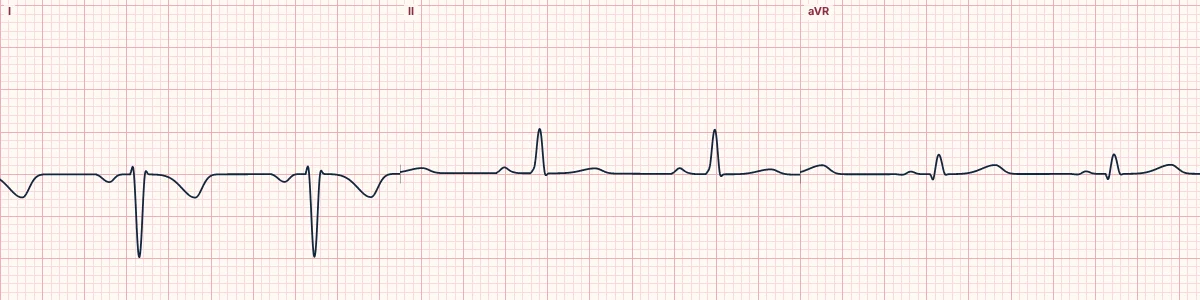
Left and right arm
Lead I inverts (negative P, QRS and T), II and III swap, and aVR and aVL swap. aVR looks upright, as in dextrocardia, but the chest leads progress normally.
Left arm and left leg
The subtlest: lead III inverts, I and II swap, and aVL and aVF swap. A P wave taller in I than in II is a clue.
Right arm and left leg
Leads I, II and III all invert (I and III also trade places), aVR and aVF swap, and aVL is unchanged.
Right leg swaps
Swapping the right leg electrode with an arm makes one lead nearly flat: lead II with the right arm, lead III with the left arm.
About the demonstration
The tracing shows left and right arm reversal, the commonest swap.
How to read it
- Look at lead I: an inverted P and QRS with normal chest leads is arm reversal until proven otherwise.
- Find a flat limb lead: it names a right leg swap.
- Compare with a previous ECG and repeat with checked placement.
Pitfalls
- Reversals can create or hide inferior Q waves and ST changes.
- Dextrocardia also inverts lead I, but its R waves shrink from V1 to V6.
Frequently asked questions
Limb electrode reversals: what is the key idea?
Swapped limb electrodes change the limb leads in predictable ways and leave the chest leads alone. Arm reversal is the commonest; swaps involving the right leg electrode make one limb lead almost flat.
Limb electrode reversals: what are the key numbers?
LA/RA: Lead I inverted; aVR upright; chest leads normal; LA/LL: Lead III inverted; P taller in I than II; RA/LL: I, II and III inverted; aVR and aVF swapped; RA/RL: Lead II almost flat; LA/RL: Lead III almost flat.
Limb electrode reversals: how do you apply it to an ECG?
Look at lead I: an inverted P and QRS with normal chest leads is arm reversal until proven otherwise. Find a flat limb lead: it names a right leg swap. Compare with a previous ECG and repeat with checked placement.
Limb electrode reversals: what are the common pitfalls?
Reversals can create or hide inferior Q waves and ST changes. Dextrocardia also inverts lead I, but its R waves shrink from V1 to V6.