
Rhythm clues and devices
Draft — pending owner review
Bix rule
Look for a second P wave
When a P wave sits halfway between two QRS complexes in a regular tachycardia, suspect another P wave hidden inside the QRS. The rhythm is probably atrial flutter or atrial tachycardia with 2:1 block.
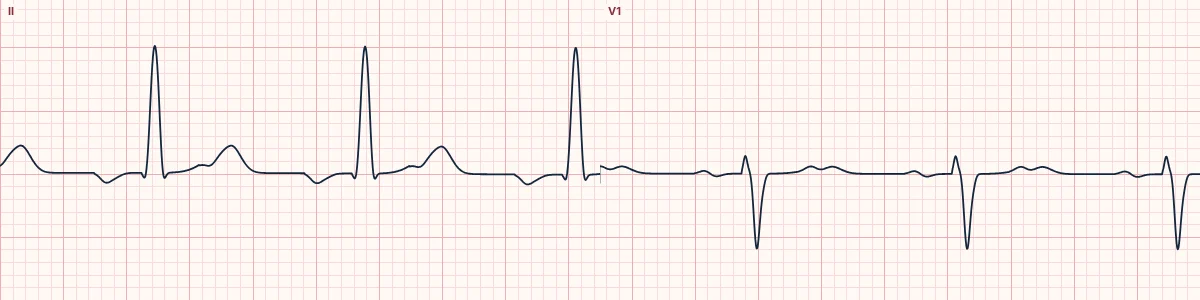
The rule
A regular narrow tachycardia with a visible P wave midway between QRS complexes is a clue. With 2:1 conduction, the next atrial impulse falls on or in the QRS, where it is easily missed.
Why it matters
Missing the hidden P turns atrial tachycardia or flutter with 2:1 block into sinus tachycardia or SVT. The true atrial rate is double what it seems, which changes the diagnosis and the treatment; in a patient taking digoxin it is a key clue to toxicity.
Unmasking it
Vagal maneuvers or adenosine briefly increase AV block and reveal the extra P waves. V1 and the inferior leads show atrial activity best.
About the demonstration
The tracing shows atrial tachycardia with 2:1 block. One P wave precedes each QRS and the other sits just after the T wave; pause it and march out the P waves with calipers to find the true atrial rate.
How to read it
- Measure the P-to-P interval from a visible P wave and step it forward.
- If the next P lands in a QRS, there is a hidden P wave.
- Check V1 and II for atrial activity.
Pitfalls
- A ventricular rate of exactly 150 should always prompt a search for flutter.
Frequently asked questions
Bix rule: what is the key idea?
When a P wave sits halfway between two QRS complexes in a regular tachycardia, suspect another P wave hidden inside the QRS. The rhythm is probably atrial flutter or atrial tachycardia with 2:1 block.
Bix rule: what are the key numbers?
Clue: A P wave halfway between QRS complexes; Suspect: Atrial flutter or atrial tachycardia with 2:1 block; True atrial rate: Twice the ventricular rate.
Bix rule: how do you apply it to an ECG?
Measure the P-to-P interval from a visible P wave and step it forward. If the next P lands in a QRS, there is a hidden P wave. Check V1 and II for atrial activity.
Bix rule: what are the common pitfalls?
A ventricular rate of exactly 150 should always prompt a search for flutter.