
Rhythm clues and devices
Draft — pending owner review
Other pacemaker problems
Oversensing, runaway pacing and pacemaker-mediated tachycardia
Beyond failure to capture and failure to sense, pacemakers can oversense, pace too fast or drive a re-entrant tachycardia, and normal device behavior is often misread as a fault.
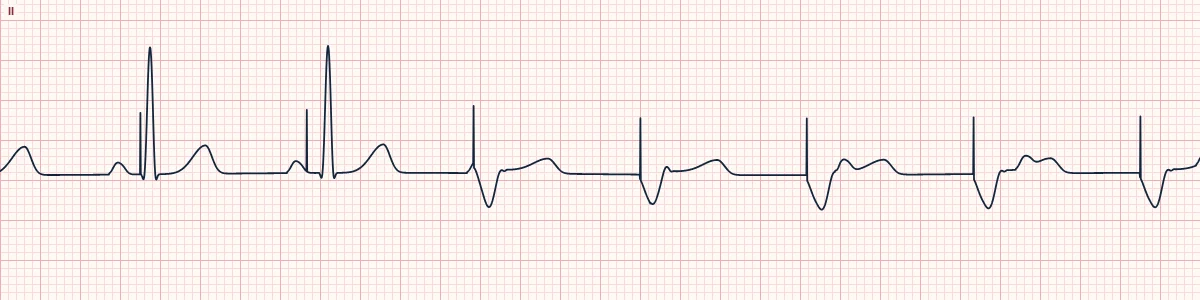
Oversensing
The pacemaker mistakes noise, muscle activity or T waves for the heart's own beats and withholds pacing. The ECG shows pauses longer than the programmed interval with no pacing spikes.
Pacemaker-mediated tachycardia
In a dual-chamber device, a retrograde P wave after a paced ventricular beat is sensed by the atrial lead and triggers another ventricular paced beat: an endless loop at or near the upper tracking rate. A magnet usually ends it.
Runaway pacemaker
A rare generator failure with very fast pacing that needs urgent action. Modern devices have rate limits that make it unusual.
Normal behavior that looks like a fault
Rate hysteresis, sleep rates, rate response and tracking of sinus tachycardia up to the upper rate limit are normal functions. So are pseudo-fusion beats, where a spike falls on the patient's own QRS.
About the demonstration
The tracing shows failure to sense, for comparison: spikes fire regardless of the patient's own beats.
How to read it
- Find out the device type and its lower and upper rates if you can.
- Check every pause for missing spikes and every spike for capture.
- Record the ECG with and without a magnet if trained to do so.
Pitfalls
- Paced rhythm at the upper rate may be appropriate tracking of sinus tachycardia.
- Electrocautery, MRI and muscle activity can cause oversensing.
Frequently asked questions
Other pacemaker problems: what is the key idea?
Beyond failure to capture and failure to sense, pacemakers can oversense, pace too fast or drive a re-entrant tachycardia, and normal device behavior is often misread as a fault.
Other pacemaker problems: what are the key numbers?
Oversensing: Pauses without spikes; Pacemaker-mediated tachycardia: Paced tachycardia at the upper tracking rate; Magnet: Usually forces fixed-rate pacing; Normal: Hysteresis, sleep rate, rate response.
Other pacemaker problems: how do you apply it to an ECG?
Find out the device type and its lower and upper rates if you can. Check every pause for missing spikes and every spike for capture. Record the ECG with and without a magnet if trained to do so.
Other pacemaker problems: what are the common pitfalls?
Paced rhythm at the upper rate may be appropriate tracking of sinus tachycardia. Electrocautery, MRI and muscle activity can cause oversensing.