
Atrial
Atrial fibrillation
Chaotic electrical activity makes the atria quiver instead of contract. There are no P waves and the ventricles respond at random, here at a controlled rate.
Last updated
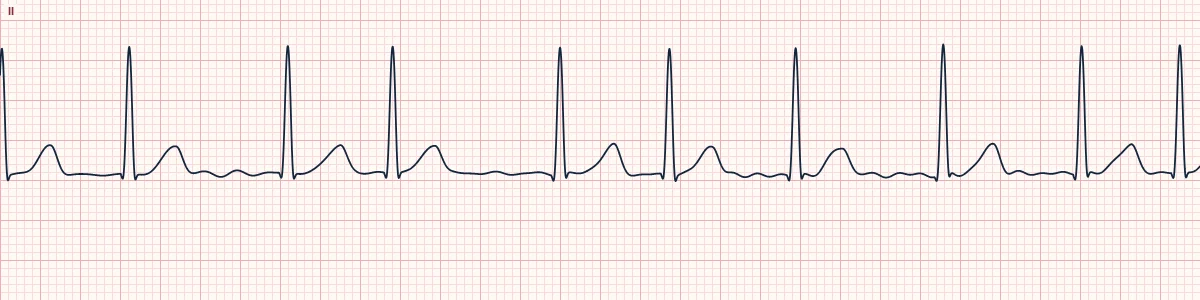
Example tracing, drawn by the lab's engine. Open the lab for a live, adjustable version.
At a glance
- Rate
- Ventricular 60–110/min (controlled)
- Rhythm
- Irregularly irregular
- P waves
- None; fine fibrillatory waves on the baseline
- PR interval
- Not measurable
Figures
Still images drawn by the lab's engine at 25 mm/s and 10 mm/mV, with the finding labeled. Select a figure to enlarge it.
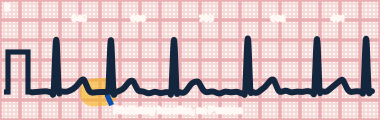
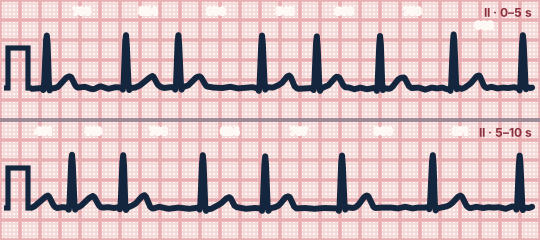
Scroll sideways to see the whole tracing, or select it to enlarge.
What the heart is doing
Hundreds of disorganized wavelets circulate through the atria. The AV node is bombarded irregularly and passes only some impulses, each along the normal pathway, so the QRS is narrow but randomly timed.
Why it looks this way
This is atrial fibrillation because the rhythm is irregularly irregular with no P waves, only a fibrillatory baseline, and narrow QRS complexes.
Why it matters
Loss of atrial contraction reduces filling and lets clot form in the left atrium, raising stroke risk. Care centers on rate or rhythm control and anticoagulation based on stroke risk.
What to look for
- No two R–R intervals match and there is no repeating pattern.
- Search II and V1 for P waves; you will find only a wavy, shifting baseline.
- Count the rate over at least 6 seconds, because single R–R intervals mislead.
Criteria
- Rate
- Ventricular 60–110/min (controlled)
- Rhythm
- Irregularly irregular
- P waves
- None; fine fibrillatory waves on the baseline
- PR interval
- Not measurable
- QRS
- Narrow (< 120 ms)
Causes
- Hypertension and aging
- Heart failure, coronary disease
- Mitral and other valve disease
- Hyperthyroidism
- Alcohol, sleep apnea
- Acute illness, surgery, pulmonary embolism
Can be mistaken for
- Multifocal atrial tachycardia or wandering pacemaker — distinct P waves before each QRS
- Atrial flutter with variable block — regular identical sawtooth waves Compare
- Sinus rhythm with frequent PACs — a dominant P wave can be found
Advanced Down to the ion channel
What the cells are doing
Pacemaker, atrial and ventricular action potentials, in step with the tracing above, with sodium, calcium and potassium moving through their channels.
Frequently asked questions
What are the ECG criteria for atrial fibrillation?
Rate: ventricular 60–110/min (controlled). Rhythm: irregularly irregular. P waves: none; fine fibrillatory waves on the baseline. PR interval: not measurable. QRS: narrow (< 120 ms).
How is atrial fibrillation identified on an ECG?
This is atrial fibrillation because the rhythm is irregularly irregular with no P waves, only a fibrillatory baseline, and narrow QRS complexes.
What can atrial fibrillation be mistaken for?
Multifocal atrial tachycardia or wandering pacemaker: distinct P waves before each QRS. Atrial flutter with variable block: regular identical sawtooth waves. Sinus rhythm with frequent PACs: a dominant P wave can be found.
What causes atrial fibrillation?
Common causes: hypertension and aging; heart failure, coronary disease; mitral and other valve disease; hyperthyroidism; alcohol, sleep apnea; and acute illness, surgery, pulmonary embolism.
Practise it in the ACLS Lab
Sources
This page does not list page-specific sources yet.
Every source the site cites, with links