
Atrial
Atrial fibrillation with rapid ventricular response
Atrial fibrillation in which the AV node lets through too many impulses, driving the ventricles faster than about 110/min and cutting filling time.
Last updated
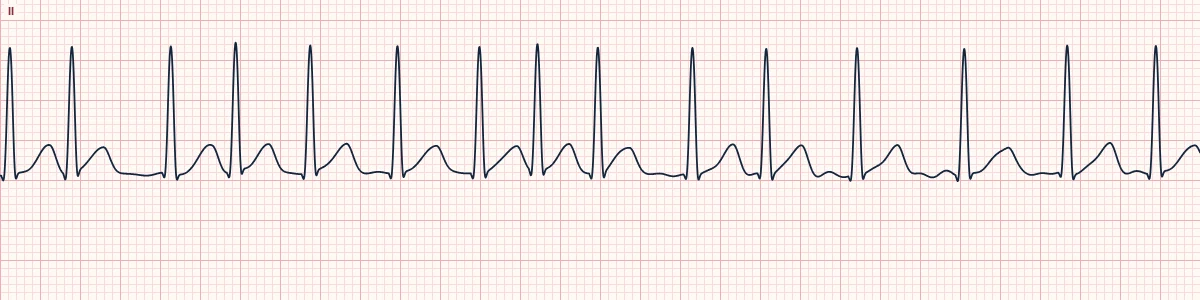
Example tracing, drawn by the lab's engine. Open the lab for a live, adjustable version.
At a glance
- Rate
- Ventricular > 100–110/min, often 120–180/min
- Rhythm
- Irregularly irregular
- P waves
- None; fibrillatory baseline
- PR interval
- Not measurable
Figures
Still images drawn by the lab's engine at 25 mm/s and 10 mm/mV, with the finding labeled. Select a figure to enlarge it.
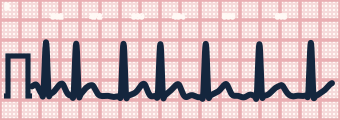
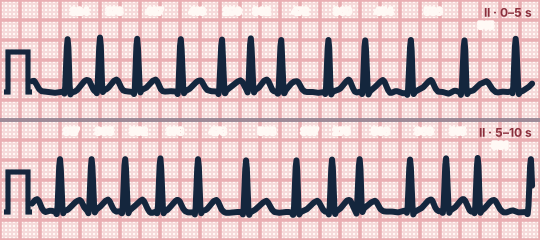
Scroll sideways to see the whole tracing, or select it to enlarge.
What the heart is doing
Chaotic atrial wavelets hit the AV node several hundred times a minute. With high sympathetic tone the node recovers quickly and conducts many of them, producing a fast, random ventricular response.
Why it looks this way
This is atrial fibrillation with rapid ventricular response because the fast rhythm is irregularly irregular with no P waves and narrow QRS complexes.
Why it matters
Short filling time can cause hypotension, ischemia and heart failure. Unstable patients need immediate synchronized cardioversion; stable patients need rate control and a search for the trigger.
What to look for
- At fast rates the rhythm can look regular; measure several R–R intervals to expose the irregularity.
- No P waves appear in any lead, even in the longer R–R gaps.
- An occasional wide beat after a long–short sequence is usually aberrancy, not a PVC.
Criteria
- Rate
- Ventricular > 100–110/min, often 120–180/min
- Rhythm
- Irregularly irregular
- P waves
- None; fibrillatory baseline
- PR interval
- Not measurable
- QRS
- Narrow unless aberrantly conducted
Causes
- Sepsis, fever, dehydration
- Heart failure, ischemia
- Pulmonary embolism, hypoxia
- Hyperthyroidism
- Alcohol or stimulant use
- Missed rate-control medication
Can be mistaken for
- AVNRT or AVRT — perfectly regular R–R intervals
- Multifocal atrial tachycardia — a visible P wave before each QRS Compare
- Pre-excited atrial fibrillation — wide QRS complexes that change shape Compare
Advanced Down to the ion channel
What the cells are doing
Pacemaker, atrial and ventricular action potentials, in step with the tracing above, with sodium, calcium and potassium moving through their channels.
Frequently asked questions
What are the ECG criteria for atrial fibrillation with rapid ventricular response?
Rate: ventricular > 100–110/min, often 120–180/min. Rhythm: irregularly irregular. P waves: none; fibrillatory baseline. PR interval: not measurable. QRS: narrow unless aberrantly conducted.
How is atrial fibrillation with rapid ventricular response identified on an ECG?
This is atrial fibrillation with rapid ventricular response because the fast rhythm is irregularly irregular with no P waves and narrow QRS complexes.
What can atrial fibrillation with rapid ventricular response be mistaken for?
AVNRT or AVRT: perfectly regular R–R intervals. Multifocal atrial tachycardia: a visible P wave before each QRS. Pre-excited atrial fibrillation: wide QRS complexes that change shape.
What causes atrial fibrillation with rapid ventricular response?
Common causes: sepsis, fever, dehydration; heart failure, ischemia; pulmonary embolism, hypoxia; hyperthyroidism; alcohol or stimulant use; and missed rate-control medication.
Practise it in the ACLS Lab
Sources
This page does not list page-specific sources yet.
Every source the site cites, with links