
Repolarization & channelopathies
Benign early repolarization
A common normal variant in healthy young people: on a narrow, normally conducted QRS, the ST segment takes off slightly above baseline with a notch at the J point and a tall upright T wave.
Last updated
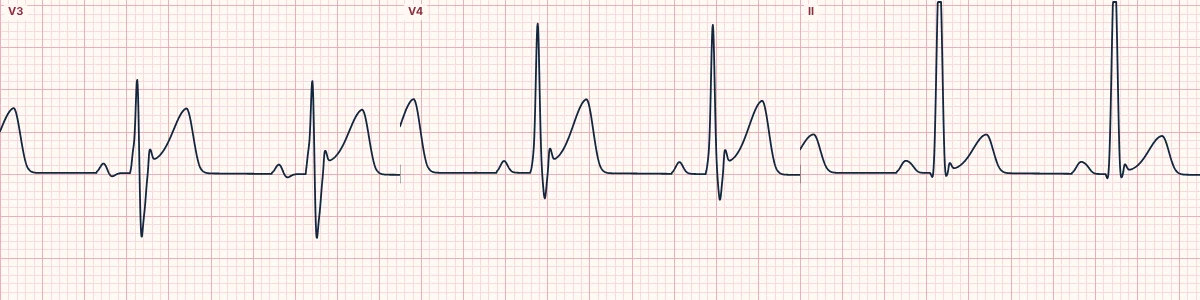
Example tracing, drawn by the lab's engine. Open the lab for a live, adjustable version.
At a glance
- QRS
- Narrow, normally conducted, often high voltage
- ST segment
- Concave elevation, usually < 3 mm; no reciprocal depression except in aVR
- J point
- Notched or slurred ('fish hook'), best in V4–V6
- V2 and V3
- S wave or J wave present; no Q waves in V2–V4
Figures
Still images drawn by the lab's engine at 25 mm/s and 10 mm/mV, with the finding labeled. Select a figure to enlarge it.
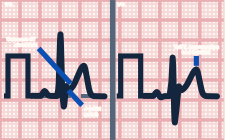
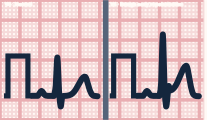
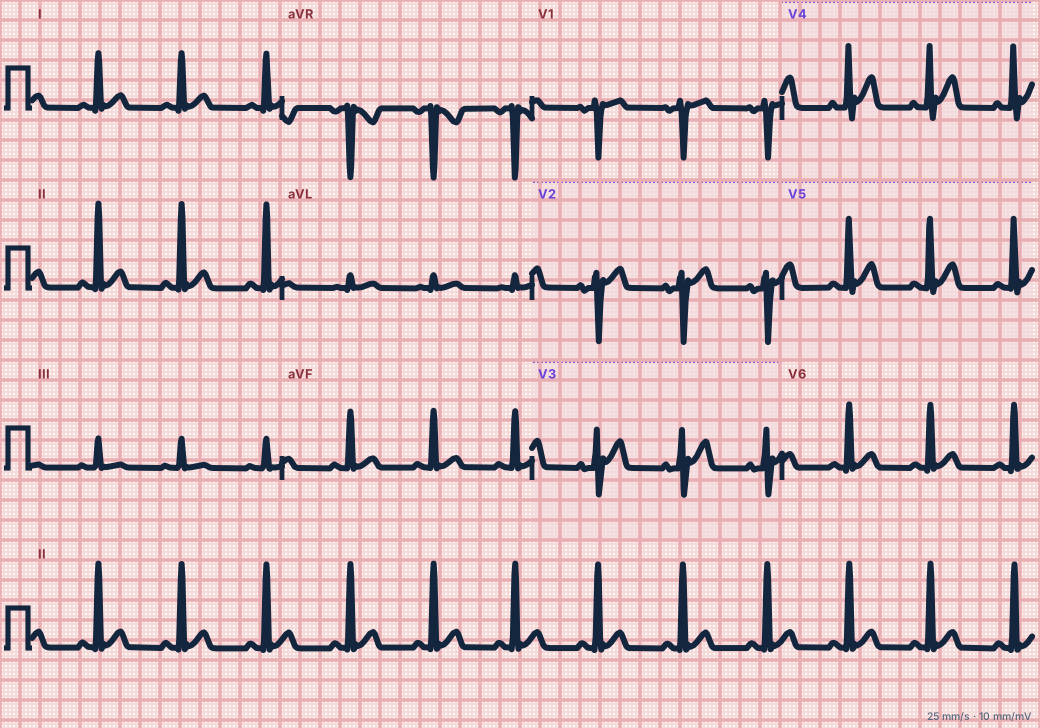
Scroll sideways to see the whole tracing, or select it to enlarge.
What the heart is doing
Differences in early repolarization currents between the outer and inner layers of the ventricular wall create a small voltage gradient at the J point, lifting the start of the ST segment.
Why it looks this way
This is benign early repolarization because concave ST elevation with a notched J point and tall T waves appears without reciprocal ST depression.
Why it matters
Harmless in most people. The danger is missing a subtle LAD occlusion: terminal QRS distortion, Q waves, reciprocal depression, hyperacute T waves or a formula value of 18.2 or more point to occlusion. It is diagnosed only on a narrow QRS; with a bundle branch block, pacing or LVH the ST follows the QRS.
What to look for
- A small notch or hook where the QRS meets the ST segment, best in V4–V6.
- The ST is concave, like a smile, and the T wave is tall but in proportion to a tall QRS.
- V2 and V3 keep an S wave or J wave, with no Q waves in V2–V4 and no reciprocal depression outside aVR.
- Dr. Stephen W. Smith's formula: 0.052·QTc − 0.151·QRS V2 − 0.268·R V4 + 1.062·STE60 V3, in ms and mm.
Criteria
- QRS
- Narrow, normally conducted, often high voltage
- ST segment
- Concave elevation, usually < 3 mm; no reciprocal depression except in aVR
- J point
- Notched or slurred ('fish hook'), best in V4–V6
- V2 and V3
- S wave or J wave present; no Q waves in V2–V4
- T waves and QTc
- T in proportion to the QRS; QTc normal or short
- Smith formula
- Below 18.2 favours early repolarization; 18.2 or more suggests LAD occlusion
Causes
- Normal variant
- Young age
- Athletic conditioning
- High vagal tone
- More common in men
Can be mistaken for
- Anterior STEMI — convex or straight ST, reciprocal depression, changes over minutes
- Pericarditis — PR depression and ST elevation large relative to the T wave Compare
- Brugada pattern — coved elevation with an inverted T wave in V1–V2 Compare
Advanced Down to the ion channel
What the cells are doing
Pacemaker, atrial and ventricular action potentials, in step with the tracing above, with sodium, calcium and potassium moving through their channels.
Frequently asked questions
What are the ECG criteria for benign early repolarization?
QRS: narrow, normally conducted, often high voltage. ST segment: concave elevation, usually < 3 mm; no reciprocal depression except in aVR. J point: notched or slurred ('fish hook'), best in V4–V6. V2 and V3: S wave or J wave present; no Q waves in V2–V4. T waves and QTc: T in proportion to the QRS; QTc normal or short. Smith formula: below 18.2 favours early repolarization; 18.2 or more suggests LAD occlusion.
How is benign early repolarization identified on an ECG?
This is benign early repolarization because concave ST elevation with a notched J point and tall T waves appears without reciprocal ST depression.
What can benign early repolarization be mistaken for?
Anterior STEMI: convex or straight ST, reciprocal depression, changes over minutes. Pericarditis: PR depression and ST elevation large relative to the T wave. Brugada pattern: coved elevation with an inverted T wave in V1–V2.
What causes benign early repolarization?
Common causes: normal variant; young age; athletic conditioning; high vagal tone; and more common in men.
Sources
This page does not list page-specific sources yet.
Every source the site cites, with links