
Inherited syndromes
Draft — pending owner review
Jervell and Lange-Nielsen syndrome
Long QT with congenital deafness
A rare, recessively inherited long QT syndrome with congenital sensorineural deafness. The QT is markedly prolonged, and the risk of torsades and sudden death in childhood is high.
Genetics
Both copies of a gene for the slow delayed-rectifier potassium current (KCNQ1 or KCNE1) are affected. The inner ear needs the same current, hence the deafness. People with one affected copy may have a milder long QT syndrome (Romano–Ward).
ECG
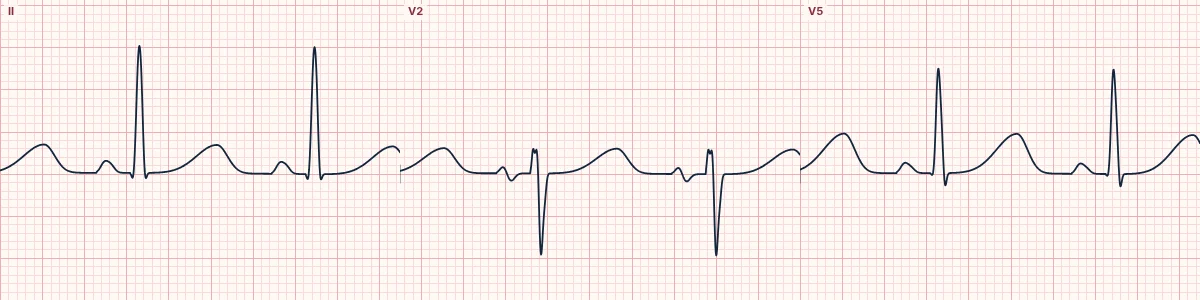
A markedly prolonged QTc, often over 500 ms, with broad or notched T waves. Arrhythmias are typically triggered by exercise, emotion or a sudden fright.
Why it matters
A child with congenital deafness and fainting, seizures or a family history of sudden death needs an ECG. Treatment includes beta-blockade and often an implanted defibrillator.
About the demonstration
The tracing shows a long QT; the cells panel shows the prolonged ventricular action potential behind it.
How to read it
- Measure the QTc carefully in any child with deafness and fainting.
- Look at T-wave shape as well as length.
- Screen family members.
Pitfalls
- Seizures in a deaf child may be arrhythmic syncope.
Frequently asked questions
Jervell and Lange-Nielsen syndrome: what is the key idea?
A rare, recessively inherited long QT syndrome with congenital sensorineural deafness. The QT is markedly prolonged, and the risk of torsades and sudden death in childhood is high.
Jervell and Lange-Nielsen syndrome: what are the key numbers?
Inheritance: Autosomal recessive; QTc: Often > 500 ms; Hearing: Congenital sensorineural deafness; Triggers: Exercise, emotion, startle.
Jervell and Lange-Nielsen syndrome: how do you apply it to an ECG?
Measure the QTc carefully in any child with deafness and fainting. Look at T-wave shape as well as length. Screen family members.
Jervell and Lange-Nielsen syndrome: what are the common pitfalls?
Seizures in a deaf child may be arrhythmic syncope.