
Electrolytes, drugs and toxins
Draft — pending owner review
Hypomagnesemia
A long QT and a tendency to torsades
Low magnesium rarely produces a pattern of its own. It prolongs the QT, encourages atrial and ventricular ectopy and predisposes to torsades de pointes, and it usually travels with low potassium and low calcium.
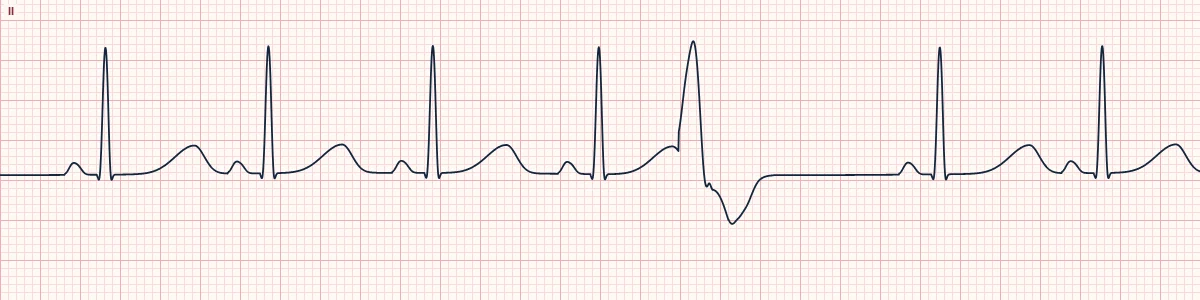
ECG changes
A prolonged QTc, sometimes a long PR, flattened T waves and U waves (largely from the low potassium that usually accompanies it), premature beats, and runs of VT or torsades de pointes.
Why it matters
Magnesium steadies the cell membrane and is needed to keep potassium inside cells. A low level makes low potassium hard to correct and lowers the threshold for torsades, which is why magnesium is the first treatment for torsades whatever the measured level.
Common settings
Alcohol use disorder, diuretics and proton-pump inhibitors, diarrhea and malnutrition, diabetic ketoacidosis and refeeding.
About the demonstration
The tracing shows a long QT with ventricular ectopy, the combination to look for. Isolated low magnesium has no unique shape.
How to read it
- Measure the QTc on every ECG with frequent ectopy.
- Check potassium and magnesium together.
- Watch for a long-short sequence before runs of polymorphic VT.
Pitfalls
- A normal blood level does not exclude a total-body deficit.
Frequently asked questions
Hypomagnesemia: what is the key idea?
Low magnesium rarely produces a pattern of its own. It prolongs the QT, encourages atrial and ventricular ectopy and predisposes to torsades de pointes, and it usually travels with low potassium and low calcium.
Hypomagnesemia: what are the key numbers?
QTc: Prolonged; Rhythm: Ectopy, VT, torsades de pointes; Companions: Low potassium and low calcium.
Hypomagnesemia: how do you apply it to an ECG?
Measure the QTc on every ECG with frequent ectopy. Check potassium and magnesium together. Watch for a long-short sequence before runs of polymorphic VT.
Hypomagnesemia: what are the common pitfalls?
A normal blood level does not exclude a total-body deficit.