
Sinus
Draft — pending owner review
Sick sinus syndrome (tachy-brady)
Sick sinus syndrome in its tachy-brady form: slow sinus beats alternate with bursts of an atrial tachyarrhythmia, and a long pause follows when the fast rhythm stops.
Last updated
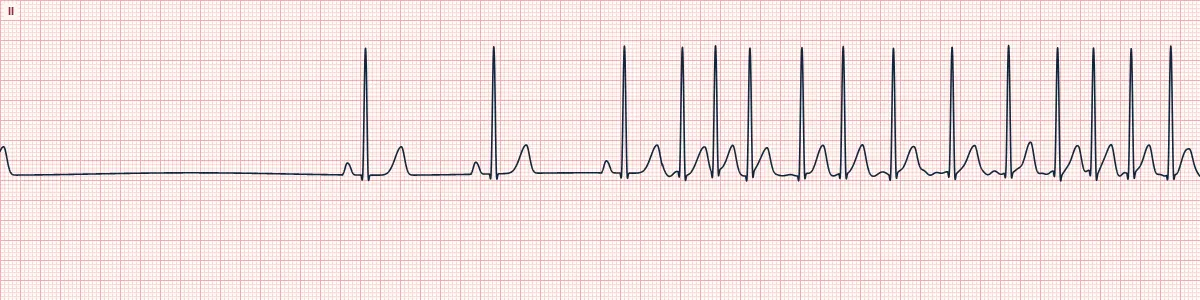
Example tracing, drawn by the lab's engine. Open the lab for a live, adjustable version.
At a glance
- Rate
- Slow sinus rate, with fast bursts (often > 120/min)
- Rhythm
- Irregular: sinus, then a burst, then a pause
- P waves
- Normal sinus P waves between bursts; none during AF
- Pause
- Often 3 s or longer after the burst ends
Figures
Still images drawn by the lab's engine at 25 mm/s and 10 mm/mV, with the finding labeled. Select a figure to enlarge it.
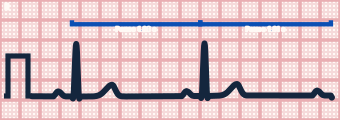
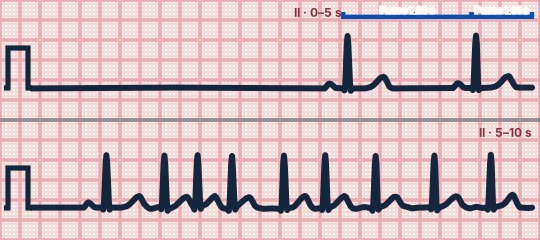
Scroll sideways to see the whole tracing, or select it to enlarge.
What the heart is doing
A diseased sinus node fires slowly and recovers poorly. During an atrial tachyarrhythmia it is suppressed (overdrive suppression), so when the burst ends the node takes seconds to fire again, leaving a long pause.
Why it looks this way
This is sick sinus syndrome (tachy-brady) because slow sinus beats alternate with bursts of atrial fibrillation, and each burst ends in a long pause before the next sinus beat.
Why it matters
Causes palpitations, dizziness and syncope. Rate-slowing drugs for the fast phase can deepen the slow phase, so many patients need a permanent pacemaker before the tachycardia can be treated. Correlate symptoms with the rhythm.
What to look for
- Read a long strip: the diagnosis is the sequence, not any single beat.
- Measure the pause after the fast rhythm stops; a pause of 3 s or more is significant.
- Look for slow sinus beats or junctional escape beats between bursts.
Criteria
- Rate
- Slow sinus rate, with fast bursts (often > 120/min)
- Rhythm
- Irregular: sinus, then a burst, then a pause
- P waves
- Normal sinus P waves between bursts; none during AF
- Pause
- Often 3 s or longer after the burst ends
- QRS
- Narrow unless there is a bundle branch block
Causes
- Age-related fibrosis of the sinus node and atria
- Ischemic heart disease
- Cardiomyopathy and infiltrative disease
- Cardiac surgery
- Drugs that slow the sinus node (worsen it)
Can be mistaken for
- Paroxysmal atrial fibrillation alone — no pause or slow sinus rhythm between bursts
- Sinus pause / arrest — pauses without any fast atrial rhythm Compare
- Blocked premature atrial complexes — an early P wave sits in the T wave before each pause
Advanced Down to the ion channel
What the cells are doing
Pacemaker, atrial and ventricular action potentials, in step with the tracing above, with sodium, calcium and potassium moving through their channels.
Frequently asked questions
What are the ECG criteria for sick sinus syndrome (tachy-brady)?
Rate: slow sinus rate, with fast bursts (often > 120/min). Rhythm: irregular: sinus, then a burst, then a pause. P waves: normal sinus P waves between bursts; none during AF. Pause: often 3 s or longer after the burst ends. QRS: narrow unless there is a bundle branch block.
How is sick sinus syndrome (tachy-brady) identified on an ECG?
This is sick sinus syndrome (tachy-brady) because slow sinus beats alternate with bursts of atrial fibrillation, and each burst ends in a long pause before the next sinus beat.
What can sick sinus syndrome (tachy-brady) be mistaken for?
Paroxysmal atrial fibrillation alone: no pause or slow sinus rhythm between bursts. Sinus pause / arrest: pauses without any fast atrial rhythm. Blocked premature atrial complexes: an early P wave sits in the T wave before each pause.
What causes sick sinus syndrome (tachy-brady)?
Common causes: age-related fibrosis of the sinus node and atria; ischemic heart disease; cardiomyopathy and infiltrative disease; cardiac surgery; and drugs that slow the sinus node (worsen it).
Practise it in the ACLS Lab
Sources
This page does not list page-specific sources yet.
Every source the site cites, with links