
Atrial
Atrial fibrillation with slow ventricular response
Atrial fibrillation with a ventricular rate below 60/min, because the AV node is diseased or heavily suppressed by drugs.
Last updated
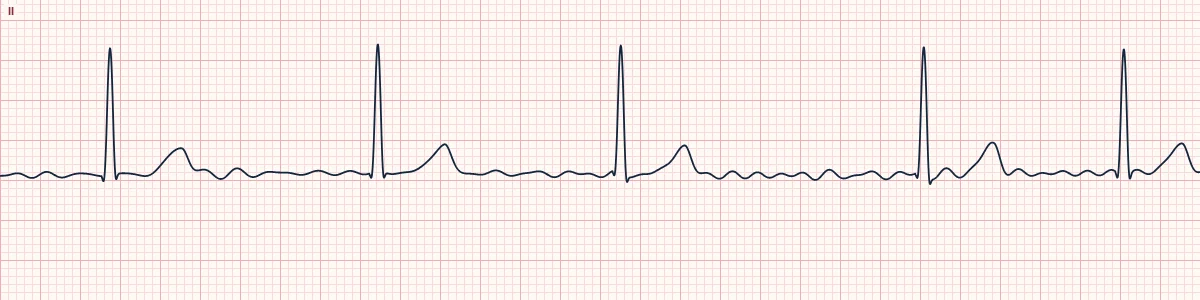
Example tracing, drawn by the lab's engine. Open the lab for a live, adjustable version.
At a glance
- Rate
- Ventricular < 60/min
- Rhythm
- Irregularly irregular
- P waves
- None; fibrillatory waves, often coarse
- PR interval
- Not measurable
Figures
Still images drawn by the lab's engine at 25 mm/s and 10 mm/mV, with the finding labeled. Select a figure to enlarge it.
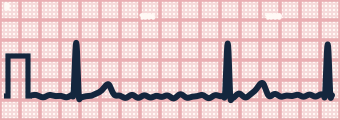
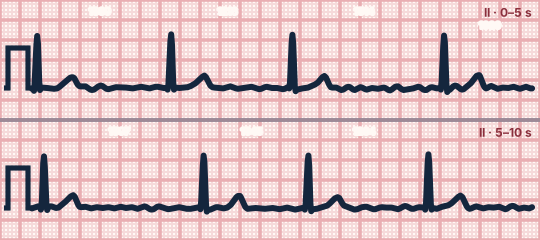
Scroll sideways to see the whole tracing, or select it to enlarge.
What the heart is doing
The atria fibrillate as usual, but a depressed AV node blocks nearly all impulses. Only occasional wavelets get through, at random intervals, giving a slow irregular ventricular rhythm.
Why it looks this way
This is atrial fibrillation with slow ventricular response because there are no P waves and the irregularly irregular narrow QRS rate is under 60/min.
Why it matters
Suspect excess rate-controlling medication or conduction disease. Symptomatic patients are managed as for other bradycardias while the cause, especially drug toxicity or hyperkalemia, is sought.
What to look for
- Long, unequal R–R intervals with a wavy baseline and no P waves between them.
- Check that the R–R intervals really vary. A slow, perfectly regular rhythm in AF means complete AV block.
- Long pauses give a clear view of the fibrillatory waves.
Criteria
- Rate
- Ventricular < 60/min
- Rhythm
- Irregularly irregular
- P waves
- None; fibrillatory waves, often coarse
- PR interval
- Not measurable
- QRS
- Narrow (< 120 ms)
Causes
- Beta-blockers, calcium-channel blockers
- Digoxin toxicity
- AV node disease
- Hypothermia
- High vagal tone
- Ischemia, hyperkalemia
Can be mistaken for
- AF with complete AV block — the slow rhythm is perfectly regular
- Junctional escape rhythm — regular, with a flat baseline Compare
- Sinus bradycardia with artifact — P waves can be found before each QRS
Advanced Down to the ion channel
What the cells are doing
Pacemaker, atrial and ventricular action potentials, in step with the tracing above, with sodium, calcium and potassium moving through their channels.
Frequently asked questions
What are the ECG criteria for atrial fibrillation with slow ventricular response?
Rate: ventricular < 60/min. Rhythm: irregularly irregular. P waves: none; fibrillatory waves, often coarse. PR interval: not measurable. QRS: narrow (< 120 ms).
How is atrial fibrillation with slow ventricular response identified on an ECG?
This is atrial fibrillation with slow ventricular response because there are no P waves and the irregularly irregular narrow QRS rate is under 60/min.
What can atrial fibrillation with slow ventricular response be mistaken for?
AF with complete AV block: the slow rhythm is perfectly regular. Junctional escape rhythm: regular, with a flat baseline. Sinus bradycardia with artifact: P waves can be found before each QRS.
What causes atrial fibrillation with slow ventricular response?
Common causes: beta-blockers, calcium-channel blockers; digoxin toxicity; AV node disease; hypothermia; high vagal tone; and ischemia, hyperkalemia.
Sources
This page does not list page-specific sources yet.
Every source the site cites, with links