
Junctional & SVT
Premature junctional complexes
Early beats that arise in the AV junction. The QRS is narrow and early; the P wave is missing, or inverted just before or after the QRS.
Last updated
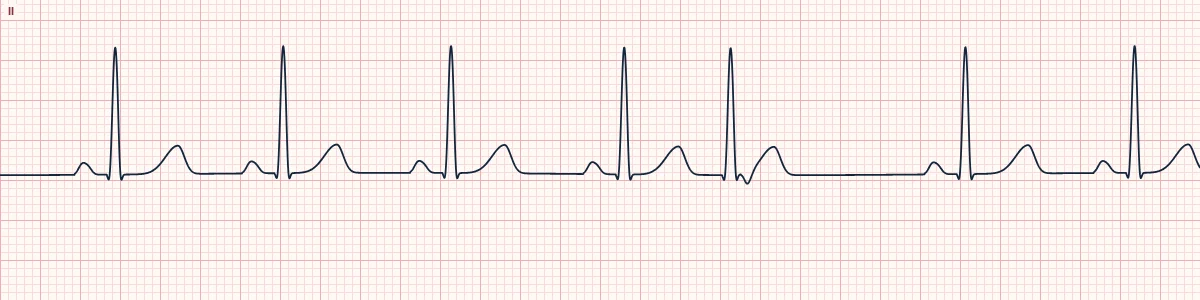
Example tracing, drawn by the lab's engine. Open the lab for a live, adjustable version.
At a glance
- Rate
- That of the underlying rhythm
- Rhythm
- Irregular because of early beats
- P waves
- Absent, or inverted in II just before or after the early QRS
- PR interval
- < 120 ms if a P wave precedes the beat
Figures
Still images drawn by the lab's engine at 25 mm/s and 10 mm/mV, with the finding labeled. Select a figure to enlarge it.
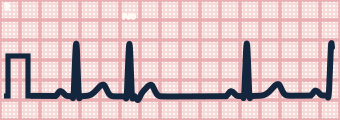
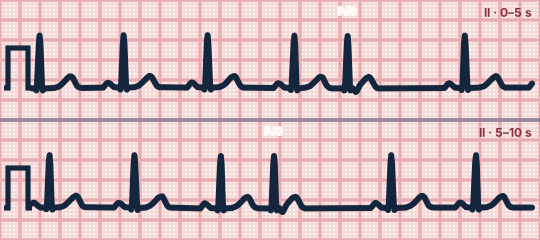
Scroll sideways to see the whole tracing, or select it to enlarge.
What the heart is doing
A focus in the AV junction fires early. The impulse travels down the His–Purkinje system normally and, at the same time, backward into the atria, producing an inverted P wave near the QRS.
Why it looks this way
These are PJCs because the early QRS is narrow and has no normal P wave before it, only an inverted retrograde P wave near the QRS.
Why it matters
Usually benign and needs no treatment. Frequent PJCs in a patient on digoxin should raise suspicion of toxicity.
What to look for
- An early narrow QRS with no normal P wave in front of it.
- Check the ST segment right after the early QRS for a small inverted retrograde P wave.
- The early beat looks like its neighbors, which separates it from a PVC.
Criteria
- Rate
- That of the underlying rhythm
- Rhythm
- Irregular because of early beats
- P waves
- Absent, or inverted in II just before or after the early QRS
- PR interval
- < 120 ms if a P wave precedes the beat
- QRS
- Narrow, like the sinus beats
Causes
- Digoxin toxicity
- Caffeine, nicotine, stimulants
- Myocardial ischemia
- Heart failure
- Electrolyte disturbance
- Normal variant
Can be mistaken for
Advanced Down to the ion channel
What the cells are doing
Pacemaker, atrial and ventricular action potentials, in step with the tracing above, with sodium, calcium and potassium moving through their channels.
Frequently asked questions
What are the ECG criteria for premature junctional complexes?
Rate: that of the underlying rhythm. Rhythm: irregular because of early beats. P waves: absent, or inverted in II just before or after the early QRS. PR interval: < 120 ms if a P wave precedes the beat. QRS: narrow, like the sinus beats.
How is premature junctional complexes identified on an ECG?
These are PJCs because the early QRS is narrow and has no normal P wave before it, only an inverted retrograde P wave near the QRS.
What can premature junctional complexes be mistaken for?
PAC: an upright or abnormal early P wave with PR ≥ 120 ms. PVC: wide, bizarre QRS with a discordant T wave. Sinus arrhythmia: every beat has the same normal P wave.
What causes premature junctional complexes?
Common causes: digoxin toxicity; caffeine, nicotine, stimulants; myocardial ischemia; heart failure; electrolyte disturbance; and normal variant.
Sources
This page does not list page-specific sources yet.
Every source the site cites, with links