
Junctional & SVT
Pre-excited atrial fibrillation (AF with WPW)
Atrial fibrillation conducted down an accessory pathway that bypasses the AV node. The result is a very fast, irregular, wide-complex rhythm that can turn into VF.
Last updated
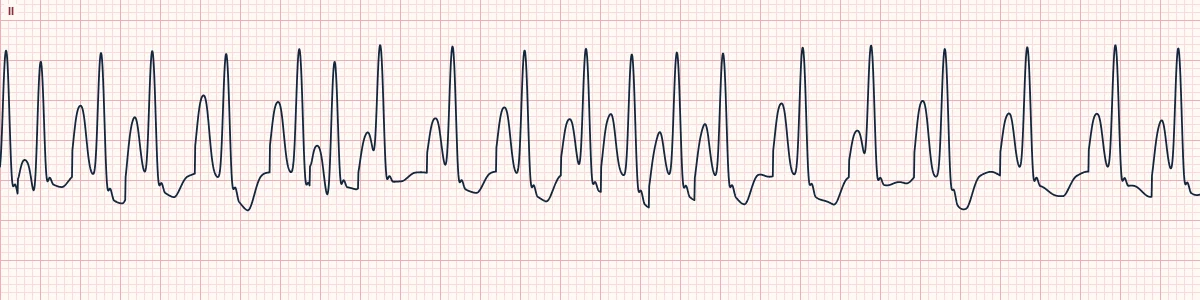
Example tracing, drawn by the lab's engine. Open the lab for a live, adjustable version.
At a glance
- Rate
- Often 180–300/min
- Rhythm
- Irregularly irregular
- P waves
- None
- QRS
- Wide, with shape and width changing beat to beat
Figures
Still images drawn by the lab's engine at 25 mm/s and 10 mm/mV, with the finding labeled. Select a figure to enlarge it.
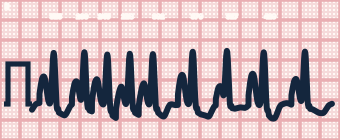
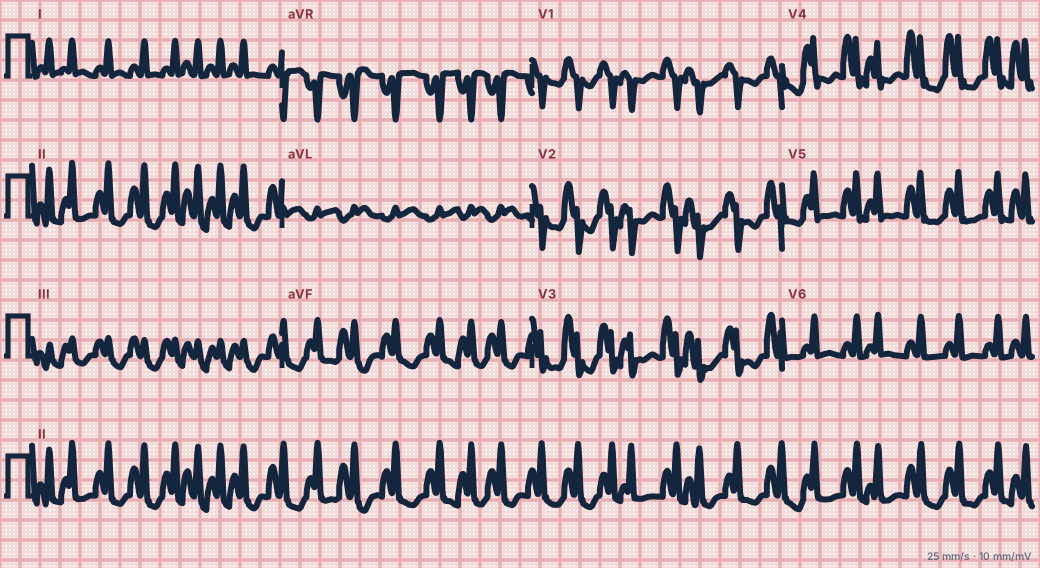
Scroll sideways to see the whole tracing, or select it to enlarge.
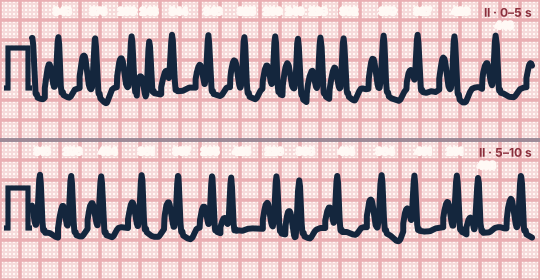
Scroll sideways to see the whole tracing, or select it to enlarge.
What the heart is doing
Fibrillating atria send impulses down both the AV node and the accessory pathway. The pathway has no built-in delay, so it conducts very rapidly and each beat is a different fusion of the two routes.
Why it looks this way
This is pre-excited atrial fibrillation because the rhythm is very fast and irregular with wide QRS complexes that keep changing shape.
Why it matters
Life-threatening. Drugs that block only the AV node (adenosine, beta-blockers, calcium-channel blockers, digoxin) can speed pathway conduction and provoke VF. Unstable patients need immediate cardioversion.
What to look for
- Fast, broad and irregular: think of pre-excited AF before anything else.
- The QRS varies from narrow to very wide as the degree of pre-excitation changes.
- The axis stays stable, unlike the twisting of polymorphic VT.
Criteria
- Rate
- Often 180–300/min
- Rhythm
- Irregularly irregular
- P waves
- None
- QRS
- Wide, with shape and width changing beat to beat
- Shortest R–R
- May be under 250 ms
Causes
- WPW with a pathway that conducts rapidly
- Onset of AF in a patient with pre-excitation
- AVRT degenerating into AF
- Alcohol or stimulants
Can be mistaken for
- Polymorphic VT — the axis twists around the baseline Compare
- AF with bundle branch block — constant QRS shape and a slower rate
- Monomorphic VT — regular rhythm with uniform complexes Compare
Advanced Down to the ion channel
What the cells are doing
Pacemaker, atrial and ventricular action potentials, in step with the tracing above, with sodium, calcium and potassium moving through their channels.
Frequently asked questions
What are the ECG criteria for pre-excited atrial fibrillation (AF with WPW)?
Rate: often 180–300/min. Rhythm: irregularly irregular. P waves: none. QRS: wide, with shape and width changing beat to beat. Shortest R–R: may be under 250 ms.
How is pre-excited atrial fibrillation (AF with WPW) identified on an ECG?
This is pre-excited atrial fibrillation because the rhythm is very fast and irregular with wide QRS complexes that keep changing shape.
What can pre-excited atrial fibrillation (AF with WPW) be mistaken for?
Polymorphic VT: the axis twists around the baseline. AF with bundle branch block: constant QRS shape and a slower rate. Monomorphic VT: regular rhythm with uniform complexes.
What causes pre-excited atrial fibrillation (AF with WPW)?
Common causes: WPW with a pathway that conducts rapidly; onset of AF in a patient with pre-excitation; AVRT degenerating into AF; and alcohol or stimulants.
Sources
This page does not list page-specific sources yet.
Every source the site cites, with links