
Wide-complex tachycardia criteria
Draft — pending owner review
Brugada algorithm for wide-complex tachycardia
Four steps toward VT
A four-step method for deciding whether a regular wide-complex tachycardia is VT. Each step asks one question of the chest leads; any yes means VT, and only four noes in a row favor SVT with aberrancy.
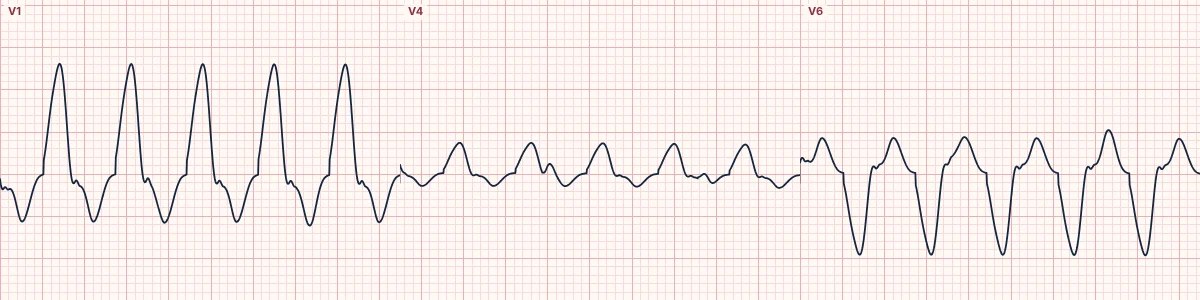
Steps one and two
Both rely on a ventricular origin spreading slowly through muscle. An RS complex anywhere in V1–V6 shows that some lead sees a fast initial activation; if no chest lead has one, the rhythm is VT. Where RS complexes exist, an interval of more than 100 ms from the start of the R wave to the deepest point of the S wave, in any chest lead, means slow initial spread: VT.
Step three
AV dissociation: P waves at their own slower rate, or capture and fusion beats, prove VT.
Step four, morphology
With an RBBB-like QRS, a monophasic R or qR in V1 and an R/S ratio under 1 or a QS in V6 favor VT. With an LBBB-like QRS, a broad initial R (over 30 ms) in V1 or V2, more than 60 ms to the nadir of the S wave, a notched S downstroke, or a qR or QS in V6 favor VT.
Limits
It was derived in patients without pre-excitation, so antidromic AVRT and pre-excited AF can be called VT. Later studies found lower accuracy than first reported. The safe default is unchanged: treat a regular wide-complex tachycardia as VT unless SVT is proven.
How to read it
- Scan V1–V6 for any RS complex.
- Where there is one, measure from the start of the R to the nadir of the S.
- Then look for dissociated P waves, and last of all the V1 and V6 shapes.
Pitfalls
- The RS interval is hard to measure at fast rates; use the clearest lead.
- Hyperkalemia and sodium-channel blockers widen the QRS and confuse every algorithm.
Frequently asked questions
Brugada algorithm for wide-complex tachycardia: what is the key idea?
A four-step method for deciding whether a regular wide-complex tachycardia is VT. Each step asks one question of the chest leads; any yes means VT, and only four noes in a row favor SVT with aberrancy.
Brugada algorithm for wide-complex tachycardia: what are the key numbers?
RS interval: > 100 ms: VT; Any step positive: VT; Derivation study: Sensitivity about 99%; lower in later studies; Not valid: With pre-excitation.
Brugada algorithm for wide-complex tachycardia: how do you apply it to an ECG?
Scan V1–V6 for any RS complex. Where there is one, measure from the start of the R to the nadir of the S. Then look for dissociated P waves, and last of all the V1 and V6 shapes.
Brugada algorithm for wide-complex tachycardia: what are the common pitfalls?
The RS interval is hard to measure at fast rates; use the clearest lead. Hyperkalemia and sodium-channel blockers widen the QRS and confuse every algorithm.