
Junctional & SVT
Junctional tachycardia
An automatic focus in the AV junction fires faster than 100/min, giving a regular narrow tachycardia with inverted P waves near the QRS or none at all.
Last updated
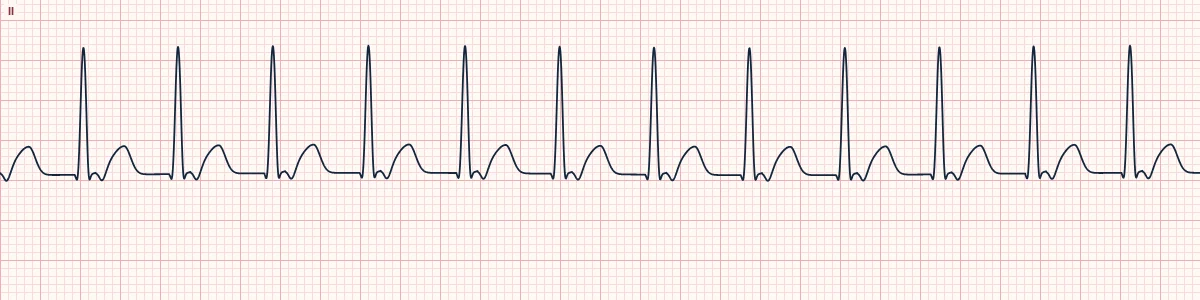
Example tracing, drawn by the lab's engine. Open the lab for a live, adjustable version.
At a glance
- Rate
- > 100/min, usually 100–180/min
- Rhythm
- Regular
- P waves
- Inverted in II, here just after the QRS; may be absent or before it
- PR interval
- None, or < 120 ms
Figures
Still images drawn by the lab's engine at 25 mm/s and 10 mm/mV, with the finding labeled. Select a figure to enlarge it.
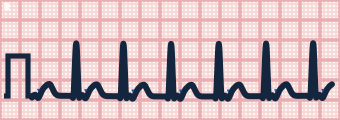
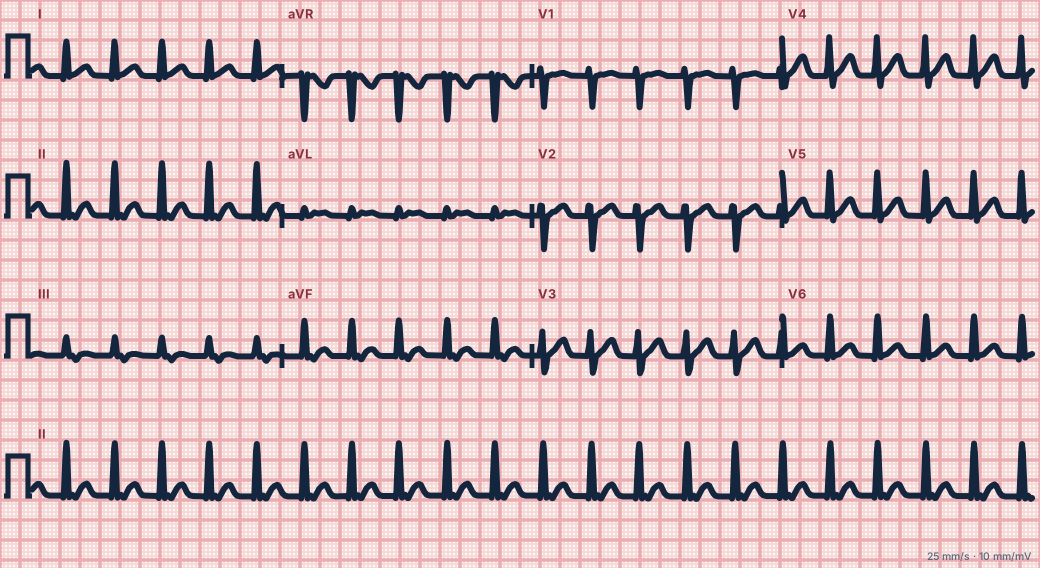
Scroll sideways to see the whole tracing, or select it to enlarge.
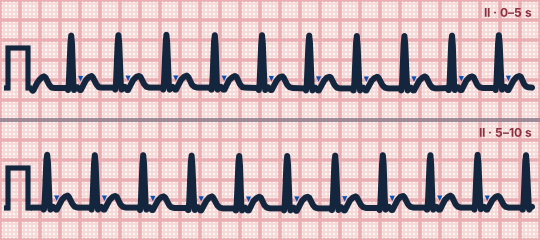
Scroll sideways to see the whole tracing, or select it to enlarge.
What the heart is doing
Junctional cells with abnormally high automaticity fire above 100/min. Each impulse descends normally to the ventricles and climbs backward into the atria, so the P wave is inverted and late.
Why it looks this way
This is junctional tachycardia because the regular narrow rhythm is above 100/min with inverted retrograde P waves and no upright P before the QRS.
Why it matters
Uncommon in adults and usually a sign of something else, especially digoxin toxicity. Treat the cause; unstable patients are managed as for other narrow tachycardias, though cardioversion may fail.
What to look for
- A regular narrow tachycardia with no upright P wave before the QRS.
- Look in the ST segment for a small negative deflection in II: the retrograde P wave.
- It speeds up and slows down gradually, unlike re-entrant SVT.
Criteria
- Rate
- > 100/min, usually 100–180/min
- Rhythm
- Regular
- P waves
- Inverted in II, here just after the QRS; may be absent or before it
- PR interval
- None, or < 120 ms
- QRS
- Narrow (< 120 ms)
Causes
- Digoxin toxicity
- After cardiac surgery, especially in children
- Myocardial ischemia or infarction
- Myocarditis
- Catecholamine excess
Can be mistaken for
- AVNRT — abrupt onset and offset, usually faster, P wave fused with the QRS Compare
- Orthodromic AVRT — abrupt onset, retrograde P wave further out in the ST segment Compare
- Sinus tachycardia with a long PR — the upright P wave is hiding in the T wave
Advanced Down to the ion channel
What the cells are doing
Pacemaker, atrial and ventricular action potentials, in step with the tracing above, with sodium, calcium and potassium moving through their channels.
Frequently asked questions
What are the ECG criteria for junctional tachycardia?
Rate: > 100/min, usually 100–180/min. Rhythm: regular. P waves: inverted in II, here just after the QRS; may be absent or before it. PR interval: none, or < 120 ms. QRS: narrow (< 120 ms).
How is junctional tachycardia identified on an ECG?
This is junctional tachycardia because the regular narrow rhythm is above 100/min with inverted retrograde P waves and no upright P before the QRS.
What can junctional tachycardia be mistaken for?
AVNRT: abrupt onset and offset, usually faster, P wave fused with the QRS. Orthodromic AVRT: abrupt onset, retrograde P wave further out in the ST segment. Sinus tachycardia with a long PR: the upright P wave is hiding in the T wave.
What causes junctional tachycardia?
Common causes: digoxin toxicity; after cardiac surgery, especially in children; myocardial ischemia or infarction; myocarditis; and catecholamine excess.
Sources
This page does not list page-specific sources yet.
Every source the site cites, with links