
Junctional & SVT
AV nodal re-entrant tachycardia (AVNRT)
The most common regular SVT: an impulse circles within the AV node, firing the atria and ventricles almost simultaneously at 140–250/min.
Last updated
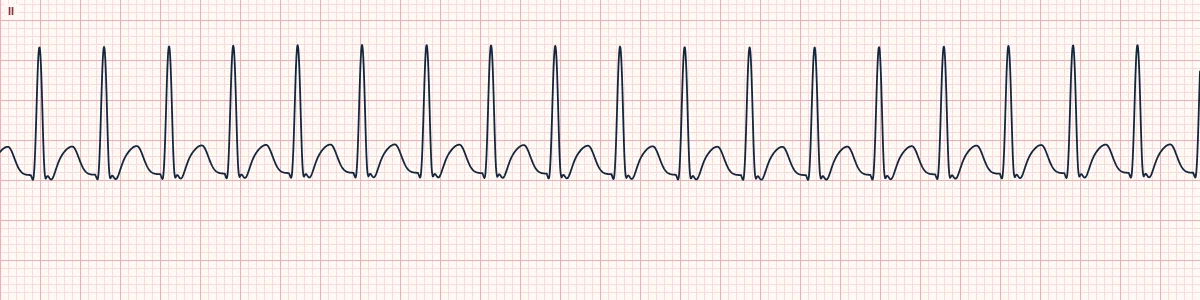
Example tracing, drawn by the lab's engine. Open the lab for a live, adjustable version.
At a glance
- Rate
- 140–250/min, often about 180
- Rhythm
- Perfectly regular; abrupt onset and offset
- P waves
- Hidden in the QRS or seen at its very end
- RP interval
- Very short (< 90 ms)
Figures
Still images drawn by the lab's engine at 25 mm/s and 10 mm/mV, with the finding labeled. Select a figure to enlarge it.
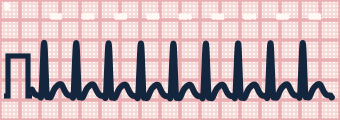
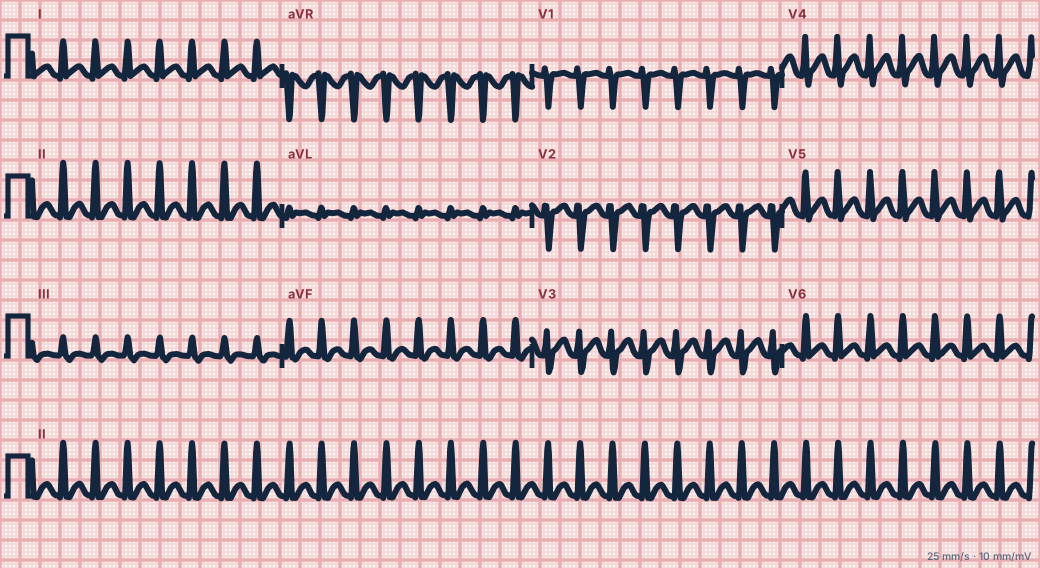
Scroll sideways to see the whole tracing, or select it to enlarge.
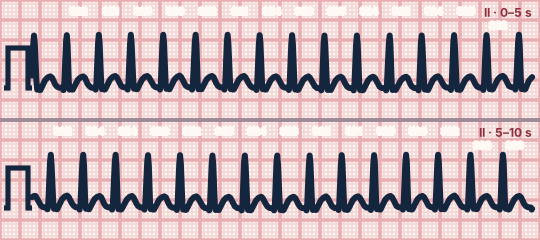
Scroll sideways to see the whole tracing, or select it to enlarge.
What the heart is doing
The AV node has a slow and a fast pathway. An early beat travels down the slow one and returns up the fast one, forming a tight loop that fires the atria and ventricles nearly together.
Why it looks this way
This is AVNRT because the narrow tachycardia is perfectly regular with the retrograde P wave buried at the very end of the QRS (RP under 90 ms).
Why it matters
Usually tolerated but uncomfortable. Stable patients are treated with vagal maneuvers, then adenosine; unstable patients need immediate synchronized cardioversion. Recurrent episodes can be cured by ablation.
What to look for
- Look at the end of the QRS: a pseudo-S wave in II, III, aVF or a pseudo-r′ in V1 is the retrograde P.
- No atrial activity is visible between the QRS complexes.
- The rate is fixed and does not drift with activity or breathing.
Criteria
- Rate
- 140–250/min, often about 180
- Rhythm
- Perfectly regular; abrupt onset and offset
- P waves
- Hidden in the QRS or seen at its very end
- RP interval
- Very short (< 90 ms)
- QRS
- Narrow (< 120 ms)
Causes
- Dual AV nodal pathways present from birth
- Triggered by a PAC or PVC
- Caffeine, alcohol, stimulants
- Stress or exertion
- Often young, otherwise healthy adults
Can be mistaken for
- Orthodromic AVRT — retrograde P wave clearly separate, in the ST segment Compare
- Atrial flutter 2:1 — rate about 150/min with sawtooth waves Compare
- Sinus tachycardia — upright P before each QRS and a gradually changing rate Compare
Advanced Down to the ion channel
What the cells are doing
Pacemaker, atrial and ventricular action potentials, in step with the tracing above, with sodium, calcium and potassium moving through their channels.
Frequently asked questions
What are the ECG criteria for AV nodal re-entrant tachycardia (AVNRT)?
Rate: 140–250/min, often about 180. Rhythm: perfectly regular; abrupt onset and offset. P waves: hidden in the QRS or seen at its very end. RP interval: very short (< 90 ms). QRS: narrow (< 120 ms).
How is AV nodal re-entrant tachycardia (AVNRT) identified on an ECG?
This is AVNRT because the narrow tachycardia is perfectly regular with the retrograde P wave buried at the very end of the QRS (RP under 90 ms).
What can AV nodal re-entrant tachycardia (AVNRT) be mistaken for?
Orthodromic AVRT: retrograde P wave clearly separate, in the ST segment. Atrial flutter 2:1: rate about 150/min with sawtooth waves. Sinus tachycardia: upright P before each QRS and a gradually changing rate.
What causes AV nodal re-entrant tachycardia (AVNRT)?
Common causes: dual AV nodal pathways present from birth; triggered by a PAC or PVC; caffeine, alcohol, stimulants; stress or exertion; and often young, otherwise healthy adults.
Practise it in the ACLS Lab
Sources
This page does not list page-specific sources yet.
Every source the site cites, with links