
Junctional & SVT
Orthodromic AV re-entrant tachycardia (AVRT)
A re-entrant SVT that uses an accessory pathway: the impulse goes down the AV node and back up the pathway, giving a narrow regular tachycardia.
Last updated
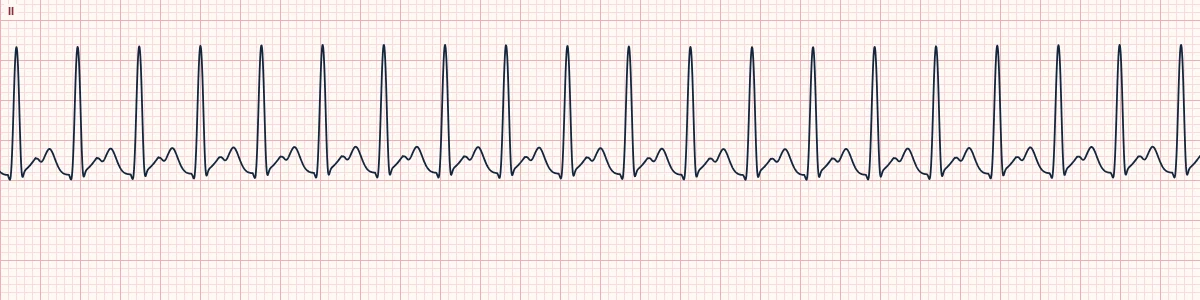
Example tracing, drawn by the lab's engine. Open the lab for a live, adjustable version.
At a glance
- Rate
- 150–250/min
- Rhythm
- Perfectly regular; abrupt onset and offset
- P waves
- Retrograde (inverted in II), in the ST segment
- RP interval
- Short but > 90 ms, and shorter than the PR
Figures
Still images drawn by the lab's engine at 25 mm/s and 10 mm/mV, with the finding labeled. Select a figure to enlarge it.
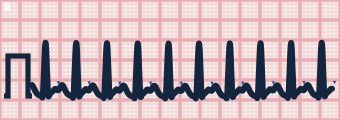
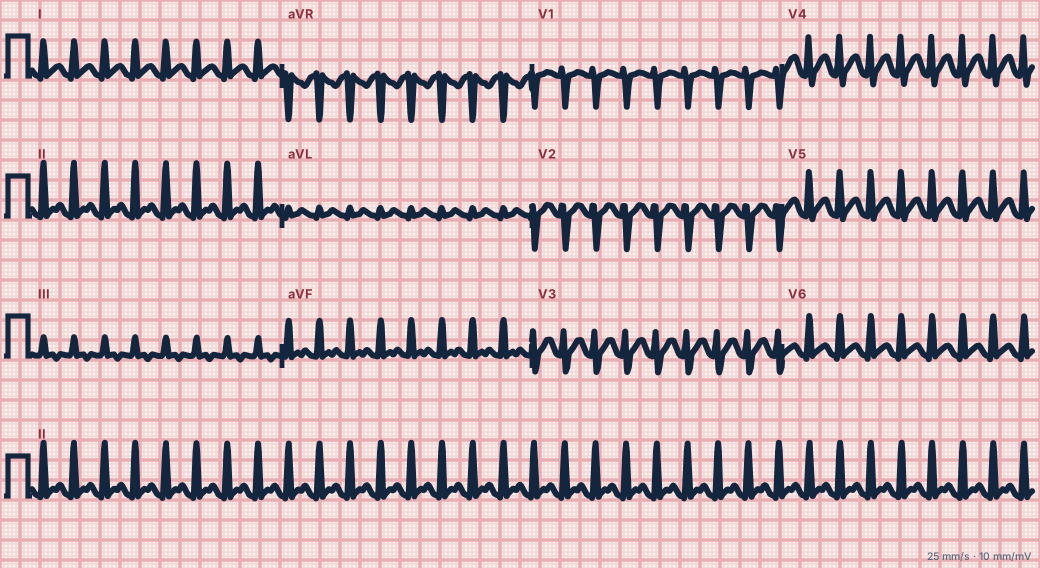
Scroll sideways to see the whole tracing, or select it to enlarge.
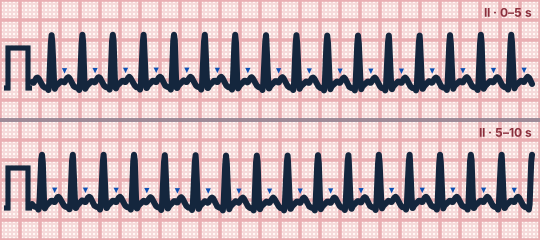
Scroll sideways to see the whole tracing, or select it to enlarge.
What the heart is doing
The impulse descends through the AV node and His–Purkinje system, then re-enters the atria through the accessory pathway. The larger loop means the atria fire well after the ventricles.
Why it looks this way
This is orthodromic AVRT because the regular narrow tachycardia has a retrograde P wave in the ST segment, with an RP over 90 ms but shorter than the PR.
Why it matters
Managed like AVNRT: vagal maneuvers, then adenosine if stable; immediate synchronized cardioversion if unstable. Refer for electrophysiology review, because the pathway can be ablated.
What to look for
- Find a small inverted P wave in the ST segment of the inferior leads, clear of the QRS.
- The delta wave seen in sinus rhythm vanishes during the tachycardia.
- Beat-to-beat alternation in QRS height at fast rates is a supporting clue.
Criteria
- Rate
- 150–250/min
- Rhythm
- Perfectly regular; abrupt onset and offset
- P waves
- Retrograde (inverted in II), in the ST segment
- RP interval
- Short but > 90 ms, and shorter than the PR
- QRS
- Narrow; no delta wave during tachycardia
Causes
- Accessory pathway (WPW or a concealed pathway)
- Triggered by a PAC or PVC
- Caffeine, alcohol, stimulants
- Stress or exertion
- Ebstein anomaly
Can be mistaken for
- AVNRT — retrograde P wave fused with the end of the QRS Compare
- Focal atrial tachycardia — P wave closer to the next QRS (long RP) Compare
- Atrial flutter 2:1 — sawtooth waves at about 300/min Compare
Advanced Down to the ion channel
What the cells are doing
Pacemaker, atrial and ventricular action potentials, in step with the tracing above, with sodium, calcium and potassium moving through their channels.
Frequently asked questions
What are the ECG criteria for orthodromic AV re-entrant tachycardia (AVRT)?
Rate: 150–250/min. Rhythm: perfectly regular; abrupt onset and offset. P waves: retrograde (inverted in II), in the ST segment. RP interval: short but > 90 ms, and shorter than the PR. QRS: narrow; no delta wave during tachycardia.
How is orthodromic AV re-entrant tachycardia (AVRT) identified on an ECG?
This is orthodromic AVRT because the regular narrow tachycardia has a retrograde P wave in the ST segment, with an RP over 90 ms but shorter than the PR.
What can orthodromic AV re-entrant tachycardia (AVRT) be mistaken for?
AVNRT: retrograde P wave fused with the end of the QRS. Focal atrial tachycardia: P wave closer to the next QRS (long RP). Atrial flutter 2:1: sawtooth waves at about 300/min.
What causes orthodromic AV re-entrant tachycardia (AVRT)?
Common causes: accessory pathway (WPW or a concealed pathway); triggered by a PAC or PVC; caffeine, alcohol, stimulants; stress or exertion; and ebstein anomaly.
Sources
This page does not list page-specific sources yet.
Every source the site cites, with links