
The waves
Naming the QRS complex
Q, R, S and R′
Each part of the QRS has a letter. Naming them precisely makes descriptions such as rSR′ in V1 or QS in V2 mean the same thing to everyone.
Last updated
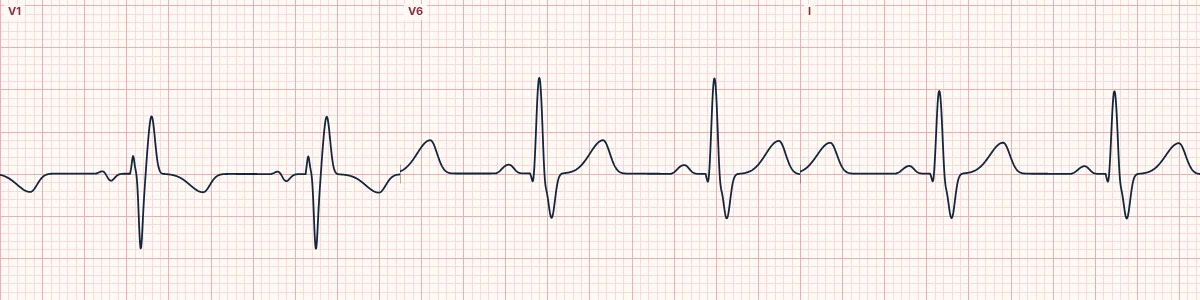
Example tracing, drawn by the lab's engine. Open the lab for a live, adjustable version.
At a glance
- Q
- First negative, before any R
- R
- Any positive
- S
- Negative after an R
- R′
- Second positive
Figures
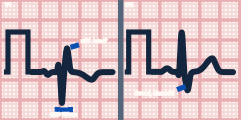
Still images drawn by the lab's engine at 25 mm/s and 10 mm/mV, with the finding labeled. Select a figure to enlarge it.
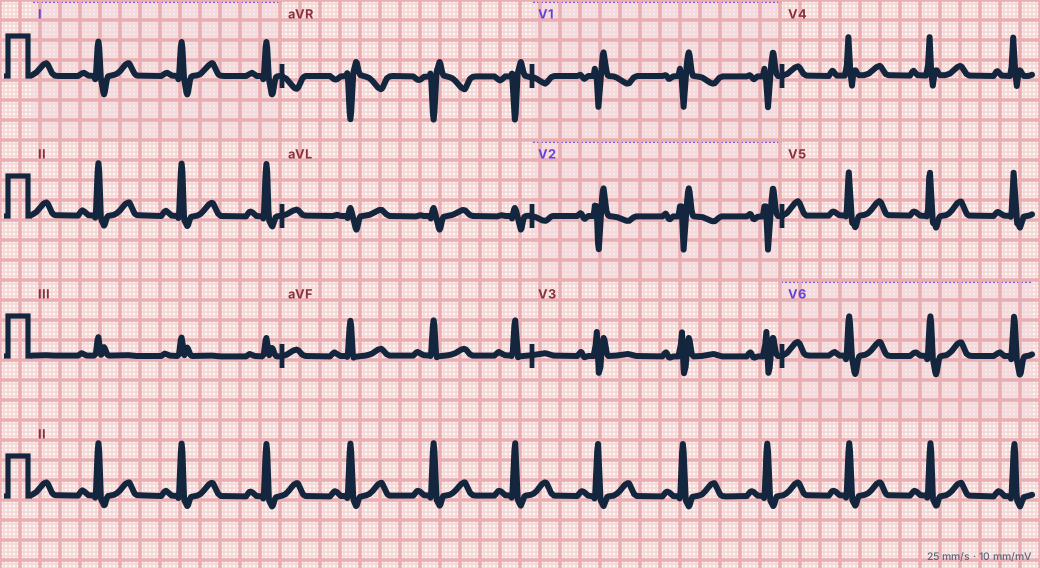
Scroll sideways to see the whole tracing, or select it to enlarge.
The letters
A Q wave is any downward deflection before the first upward one. An R wave is any upward deflection. An S wave is a downward deflection after an R. A second upward deflection is R′ (R prime). A complex that is entirely negative is a QS.
Capitals and small letters
Large waves get capital letters and small ones lower-case letters, so rS is a small r and a deep S (normal in V1) and qR is a small q and tall R (normal in V6).
What normal looks like
Small, narrow septal q waves are normal in I, aVL, V5 and V6: they record the septum activating from left to right. The QRS is normally under 120 ms wide.
How to read it
- Name each complex by its parts in order.
- Use rSR′ in V1 as the pattern to recognise right bundle branch block.
- A wide, notched R in V6 with a QS or rS in V1 suggests left bundle branch block.
Pitfalls
- Small septal q waves are normal; pathological Q waves are wide or deep.
Key numbers
- Q
- First negative, before any R
- R
- Any positive
- S
- Negative after an R
- R′
- Second positive
- QS
- Entirely negative
Advanced Down to the ion channel
What the cells are doing
Pacemaker, atrial and ventricular action potentials, in step with the tracing above, with sodium, calcium and potassium moving through their channels.
Frequently asked questions
Naming the QRS complex: what is the key idea?
Each part of the QRS has a letter. Naming them precisely makes descriptions such as rSR′ in V1 or QS in V2 mean the same thing to everyone.
Naming the QRS complex: what are the key numbers?
Q: First negative, before any R; R: Any positive; S: Negative after an R; R′: Second positive; QS: Entirely negative.
Naming the QRS complex: how do you apply it to an ECG?
Name each complex by its parts in order. Use rSR′ in V1 as the pattern to recognise right bundle branch block. A wide, notched R in V6 with a QS or rS in V1 suggests left bundle branch block.
Naming the QRS complex: what are the common pitfalls?
Small septal q waves are normal; pathological Q waves are wide or deep.
Sources
This page does not list page-specific sources yet.
Every source the site cites, with links