
AV blocks
AV dissociation (accelerated junctional rhythm)
The atria and ventricles beat independently, but because a lower pacemaker runs at least as fast as the sinus node, not because conduction is blocked. P waves drift in and out of the QRS complexes.
Last updated
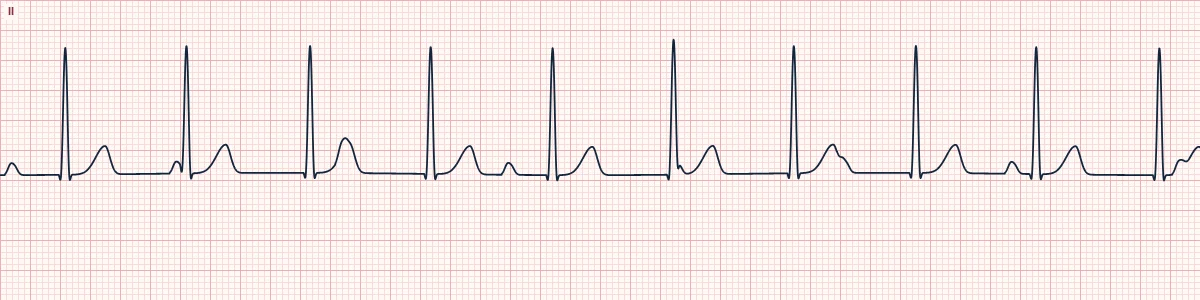
Example tracing, drawn by the lab's engine. Open the lab for a live, adjustable version.
At a glance
- Rates
- Ventricular rate equal to or faster than the atrial rate
- Rhythm
- QRS regular; P waves regular at their own rate
- P waves
- Sinus P waves that move relative to the QRS
- PR interval
- Varies; no fixed relationship
Figures
Still images drawn by the lab's engine at 25 mm/s and 10 mm/mV, with the finding labeled. Select a figure to enlarge it.
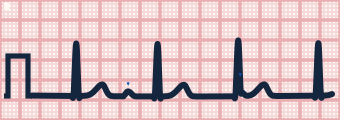
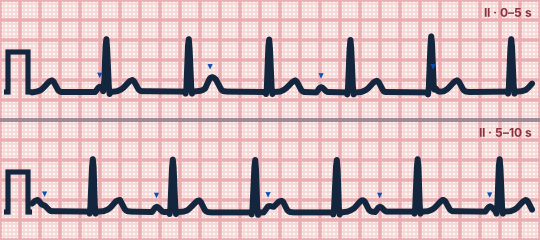
Scroll sideways to see the whole tracing, or select it to enlarge.
What the heart is doing
A junctional (or ventricular) pacemaker fires slightly faster than the sinus node. Each of its beats leaves the AV node refractory, so most sinus impulses arrive too soon to conduct; one that arrives late enough captures the ventricles.
Why it looks this way
This is AV dissociation because independent P waves march through a regular narrow rhythm that is faster than the atrial rate, and a well-timed P wave can still conduct.
Why it matters
A description, not a diagnosis: name the rhythm driving the ventricles and why the sinus node is slower. Unlike complete heart block, the AV node can still conduct, as capture beats prove. In a wide-complex tachycardia it strongly favors VT.
What to look for
- Compare the rates: here the QRS rate is faster than or equal to the P-wave rate.
- March out the P waves; they hide in the QRS, then reappear before or after it.
- Look for a capture beat: an early QRS after a P wave that lands well after the T wave.
Criteria
- Rates
- Ventricular rate equal to or faster than the atrial rate
- Rhythm
- QRS regular; P waves regular at their own rate
- P waves
- Sinus P waves that move relative to the QRS
- PR interval
- Varies; no fixed relationship
- Capture beats
- A well-timed P wave can conduct, arriving early
Causes
- Accelerated junctional rhythm (digoxin toxicity, after cardiac surgery, myocarditis)
- Accelerated idioventricular rhythm after reperfusion
- Ventricular tachycardia
- Sinus slowing with a normal junctional escape
- High vagal tone
Can be mistaken for
- Third-degree AV block, junctional escape — the atrial rate is faster than the ventricular rate and no P wave ever conducts Compare
- Accelerated junctional rhythm — no independent sinus P waves Compare
- Wandering atrial pacemaker — P-wave shape changes and every P wave conducts Compare
Advanced Down to the ion channel
What the cells are doing
Pacemaker, atrial and ventricular action potentials, in step with the tracing above, with sodium, calcium and potassium moving through their channels.
Frequently asked questions
What are the ECG criteria for AV dissociation (accelerated junctional rhythm)?
Rates: ventricular rate equal to or faster than the atrial rate. Rhythm: QRS regular; P waves regular at their own rate. P waves: sinus P waves that move relative to the QRS. PR interval: varies; no fixed relationship. Capture beats: A well-timed P wave can conduct, arriving early.
How is AV dissociation (accelerated junctional rhythm) identified on an ECG?
This is AV dissociation because independent P waves march through a regular narrow rhythm that is faster than the atrial rate, and a well-timed P wave can still conduct.
What can AV dissociation (accelerated junctional rhythm) be mistaken for?
Third-degree AV block, junctional escape: the atrial rate is faster than the ventricular rate and no P wave ever conducts. Accelerated junctional rhythm: no independent sinus P waves. Wandering atrial pacemaker: P-wave shape changes and every P wave conducts.
What causes AV dissociation (accelerated junctional rhythm)?
Common causes: accelerated junctional rhythm (digoxin toxicity, after cardiac surgery, myocarditis); accelerated idioventricular rhythm after reperfusion; ventricular tachycardia; sinus slowing with a normal junctional escape; and high vagal tone.
Sources
This page does not list page-specific sources yet.
Every source the site cites, with links